

The productivity numbers look great on paper. The reality is that most of those saved hours are going straight back into feeding, checking, and cleaning up after the AI that saved them. This edition we look at why the gap between individual productivity gains and organizational outcomes keeps widening, how the shift from AI assistants to agents is changing what work gets attempted rather than just how fast it gets done, and why the organizations most confident in their AI security are somehow among the most exposed.
AI News 📰
Why am I spending more time babysitting AI than actually working?

The trend: 87% of digital workers now use AI at work, 75% say it makes them more productive, saving roughly 11 hours a week. Only 13% say their organization is performing significantly better as a result.
The details: The Work AI Institute's 2026 index of 6,000 workers found that most of those 11 hours aren't resulting in higher-value work. They're being swallowed by "botsitting": feeding AI context, supervising outputs, and fixing mistakes. Workers spend an average of 6.4 hours a week on it, more than they actually use AI. 69% also admit to "botshitting": shipping AI-generated work they haven't fully reviewed, don't understand, or couldn't defend if asked.

Why it matters: Increased productivity only matters if the time AI saves doesn’t get used babysitting it to achieve those gains. Most organizations are measuring adoption rates and token counts rather than if the quality of work is really increasing.
AI Agents are reshaping knowledge work
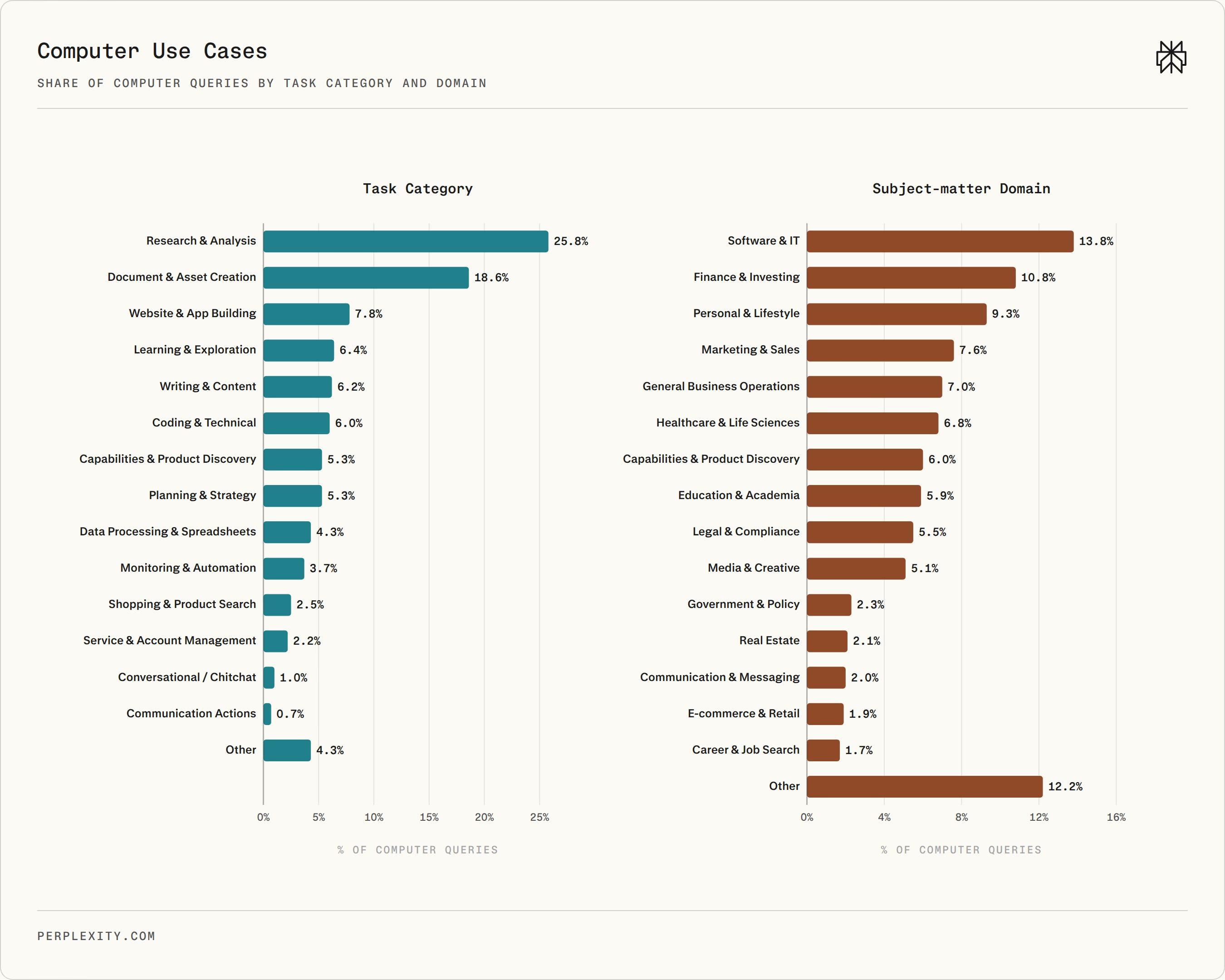
The trend: A Harvard and Perplexity study found that AI agents perform 48 times more work per session than conversational AI on the same tasks, reducing average task time by 87% and task cost by 94%.
The details: Analyzing 100,000 real Perplexity Computer (Perplexity’s AI Agent offering) sessions, they found that using an AI assistant vs an AI agent fundamentally changes what users attempt, not just how fast they do it. Computer users work outside their primary occupation 59% of the time, compared to 50% for search users, and 76% of agent queries require higher-order cognition versus 55% for conversational search. 23% of agent queries involve tasks the same users never attempted with conversational AI at all. The user's role shifts from executing work to specifying goals, supplying context, and reviewing outputs.
Why it matters: Agents don't just speed up existing work, they change what work gets done and by whom. The user's bottleneck shifts to specifying goals and supplying context, which means the quality of the data and business logic underneath determines how useful the agent actually is. That's why we're building MCP integration, so users can bring the same data capabilities to whichever agent they're already working in.
Trending Now ⚡
Execs agree that AI needs to be trustworthy, but don’t know how to make it so

A survey of more than 150 executives found that 71% say trust in AI is key to achieving business outcomes, but fewer than half say they have effective structures in place to actually build it. The gap is not about awareness: most executives already agree that trust matters. The problem is execution. Responsibility for AI governance is spread across product, technology, risk, and legal teams with no single function owning it, and traditional corporate oversight models built for slower decisions struggle to keep pace. The emerging recommendation is to stop treating trust as a governance layer added after the fact and instead embed accountability, transparency, and compliance directly into AI workflows by design.
The more AI code you ship, the more vulnerable you are

Checkmarx's 2027 Outlook Report found that nearly half of all production code is now AI-generated, and 70% of developers say that shift introduced more vulnerabilities than manual code. Organizations where 81-100% of code is AI-generated ship vulnerable code at 3.4 times the rate of those at 1-20% adoption. Those rating themselves "highly mature" report the highest AI code volumes, the highest rates of shipping vulnerable code, and breach rates barely different from the rest of the industry. Meanwhile, 95% of CISOs say they've been pressured to suppress or delay security findings, and 75% knowingly deploy vulnerable code to meet deadlines. The tools exist and largely work. The problem is that organizations have normalized the gap between identifying risk and acting on it.
Read This 📚
Anthropic suspended access to its most powerful new models, Mythos and Fable 5, after the Trump administration ordered a block on all foreign access - even by Anthropic’s own employees
This was quickly followed by an open letter signed by 100+ cybersecurity execs and researchers urging the US to lift the ban, believing the decision to be misguided
Here’s what our CEO Paul Coggins had to say on the news

Jeff Bezos’ AI startup Prometheus is planning to build “artificial general engineers” that can design and manufacture complex physical products
SpaceX IPO’d on Friday, with shares jumping 19% - making Elon Musk the world’s first trillionaire
Harvard longevity scientist David Sinclair is testing a pill he claims could make you biologically 10 years younger, using a method called chemical reprogramming
China has approved the world’s first commercial brain implant, intended for use in patients with spinal cord injuries
Why AI hasn’t replaced software engineers, and won’t
Thanks for reading!
Henry