

The cost of AI is rising faster than the returns, and the web most of us grew up with may just have ended. This edition we look at why Google’s overhaul of search is handing control of information to a single intermediary, why the economics of AI adoption are catching even the biggest tech companies off guard, and what it means for financial services when half your workforce’s tasks are automatable but the talent pipeline is drying up at the same time.
AI News 📰
AI could automate 50% of tasks in financial services
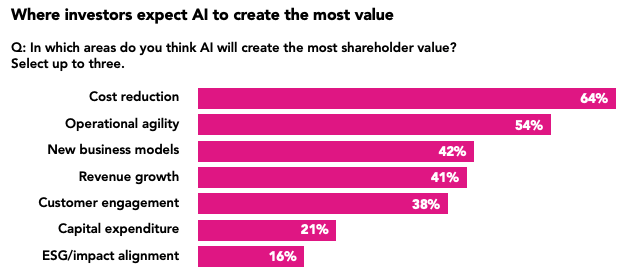
The trend: AI could automate 30-50% of tasks across most financial services roles, at a time when the sector could be losing 450,000 workers by 2035 via turnover and retirement.
The details: A UK government report warns that entry level roles will bear the brunt of automation as AI adoption grows, while demand grows for skills in data, governance and AI system design. HSBC’s CEO told staff this week that agentic AI “will destroy certain jobs and will create new jobs” and JPMorgan’s Jamie Dimon told Bloomberg that they expect to hire more AI specialists and fewer bankers going forward.
Why it matters: The roles disappearing first are ones built around repeatable, process driven work. Financial services firms that already have clean, unified data will be able to use AI for growth, rather than just cutting costs.
Did Google just kill search as we know it?
The trend: Google is replacing ranked links with an AI-powered conversational experience, with already measurable consequences. 58% of users are less likely to click a link when an AI overview appears first, and 10 major tech news outlets have already lost as much as 97% of their US Google traffic.
The details: At Google I/O the company unveiled an overhauled search function centered around an ‘intelligent search box’ that expands into a chatbot. Current AI Overviews reach 2.5 billion monthly users, and the new search will encourage follow up questions rather than scrolling to links. Users will also be able to deploy background agents to continuously monitor the web and give updates without any manual searching.
Why it matters: Most people will never know they’ve been given a wrong answer, trusting a confident AI summary. Google’s AI summaries are inaccurate roughly 9% of the time, which across trillions of annual queries adds up to tens of millions of wrong answers every hour.
Trending Now ⚡
More than half the code being shipped today wasn’t written by a human
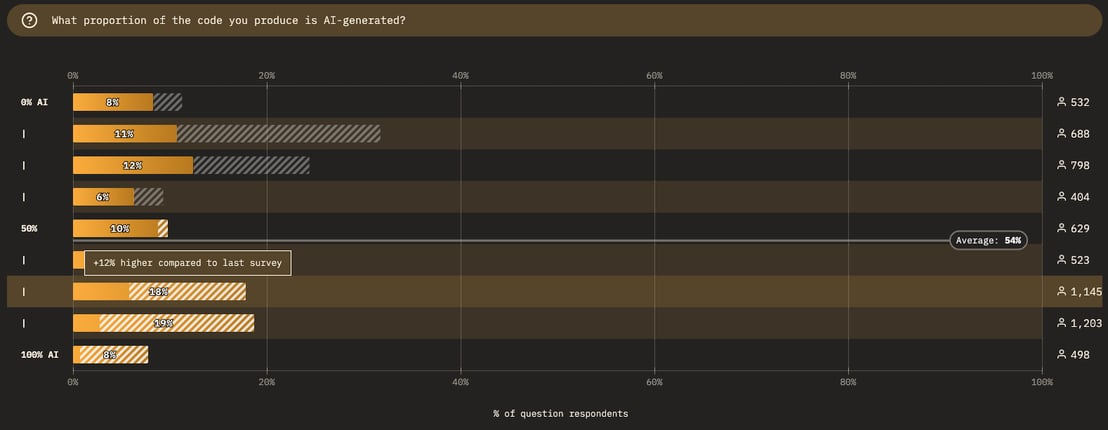
The 2026 State of Web Dev AI survey of 7,258 developers found that the proportion AI-generated code produced by devs jumped from 28% in 2025 to 54% this year, with the highest growth in the segment producing more than 75% AI-generated code. The percentage of devs using AI tools “constantly” doubled year-over-year. Claude leads on paid adoption, with more devs and companies paying for Claude than any other model, despite ChatGPT having a larger overall user base, driven largely by Claude Code topping sentiment rankings among coding agents. This massive growth isn’t without its problems though. Hallucinations and inaccuracies remain the most cited pain points, and nearly half of respondents agree or strongly agree that AI poses a threat to their job security.
Using AI is becoming more expensive than paying human employees
The economics of replacing humans with AI are turning out to be more complicated than first implied. Microsoft has begun canceling most of its internal Claude Code licenses just six months after encouraging thousands of employees to adopt the tool, and Uber’s CTO revealed in April the company burned through its entire 2026 AI coding budget in just four months. Nvidia’s Bryan Catanzaro says “For my team, the cost of compute is far beyond the costs of the employees.” Gartner projects inference costs will fall nearly 90% by 2030, but predicts enterprise bills will still rise because agentic workflows consume far more tokens per task and providers are unlikely to pass savings through to customers in full.
Read This 📚
Pope Leo XIV warned that AI must be ‘disarmed’ and must serve humanity rather than concentrate power in his first major encyclical.
Is the AI job apocalypse overblown? Goldman Sachs’ CEO thinks so.
McKinsey are rethinking consulting fees because of AI, switching from billable hours to outcome based pricing for a growing number of clients.
Congress is launching an investigation into insider trading on Kalshi and Polymarket, citing “a growing pattern of insider trading activity on prediction market platforms”.
Meta released a Reddit-like app for groups on Facebook called Forum.
Ferrari launched their first ever EV, designed by Jony Ive. The Luce’s $640,000 price tag and polarizing design drove a 6% drop in Ferrari shares.
Starbucks scrapped their AI inventory system after just 9 months, due to miscounting and mislabeling of products.
Thanks for reading!
Henry